 Shoopy
Best ecommerce platform for a fashion brand in India (2026)
Shopify, WooCommerce, Dukaan and Shoopy compared for a fashion brand in India: stock per size and colour, fees on each order, COD, returns and what to check.
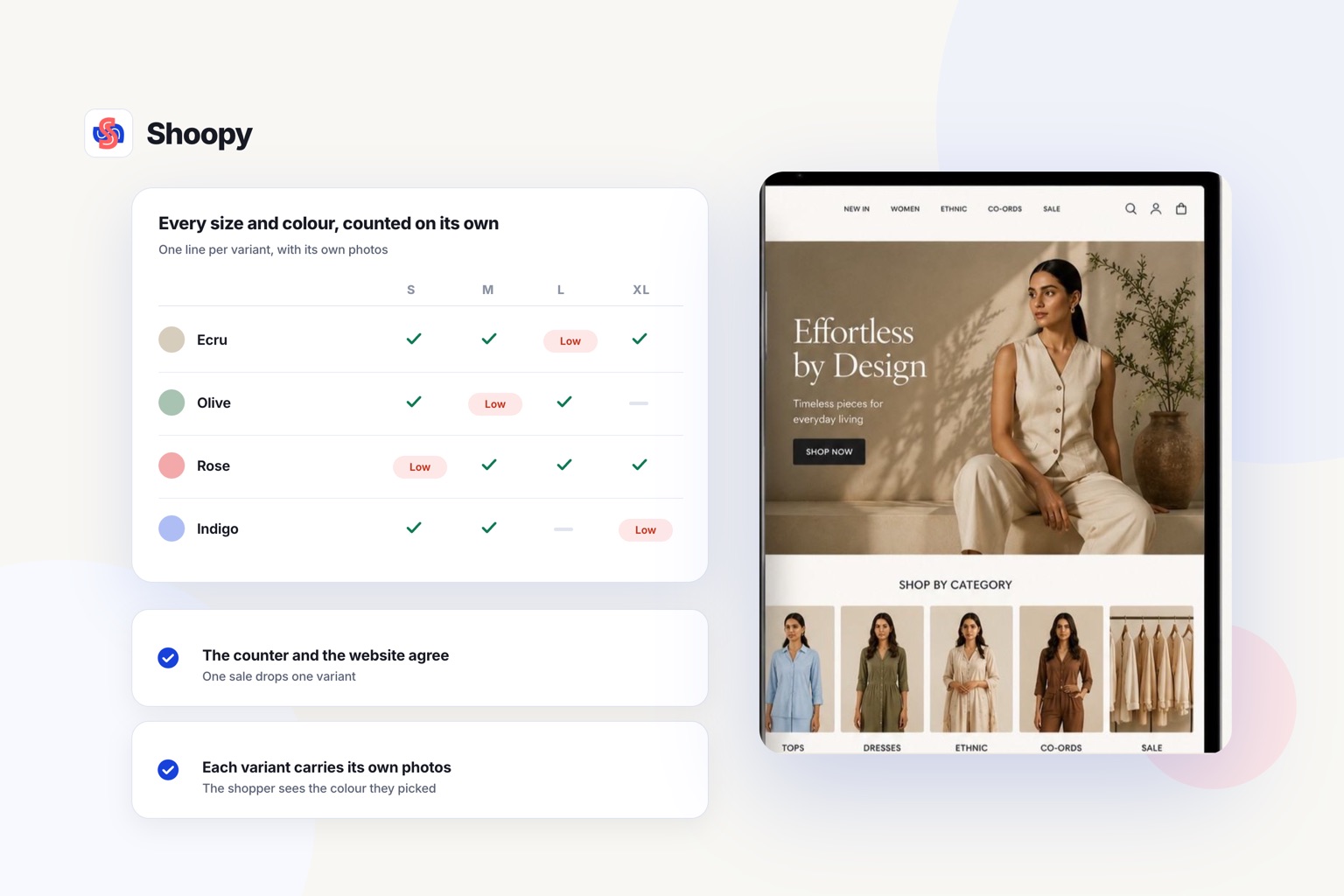
Quick Answer: Shopify, WooCommerce, Dukaan and Shoopy are four ecommerce platforms a fashion brand in India can compare. Check that each size and colour gets its own stock count and photos, and the fee on each prepaid order. Shoopy runs the storefront, branded app and counter billing from one catalogue, so a shop and its online store share one stock count.
An ecommerce platform is the software behind your online store: the catalogue, the checkout and the order list. A clothing catalogue is harder to run than a list of single items, because one kurta in five sizes and three colours is 15 separate items to count. This guide sorts four platforms by the kind of brand each suits, not by rank.
How do Shopify, WooCommerce, Dukaan and Shoopy compare for a clothing catalogue?
Four platforms a fashion brand in India can compare are Shopify, WooCommerce, Dukaan and Shoopy. Each rival’s row quotes one fact from its own page. The last column says what to ask about your own clothing catalogue.
| Platform | What its own page says | What to ask for a clothing catalogue |
|---|---|---|
| Shopify | As of October 2026, Shopify’s India pricing page lists a fee of 2% (Basic), 1% (Grow) or 0.6% (Advanced) on each order paid through a third-party payment provider | Which gateway will you use, and what will the total fee be at your monthly order count? |
| WooCommerce | As of October 2026, WooCommerce’s guide to variable products shows a t-shirt in several sizes and colours, where each variation can carry its own price, stock, image and SKU | Who will build the store, and who will keep it updated each month? |
| Dukaan | As of October 2026, Dukaan’s pricing page lists a service fee on sales of 4.99%, 3.99%, 1.99% or 0.99%, depending on the plan. Dukaan’s page says the fee does not apply to manual orders and has a cap on each order | Which plan matches your expected orders once the range grows? |
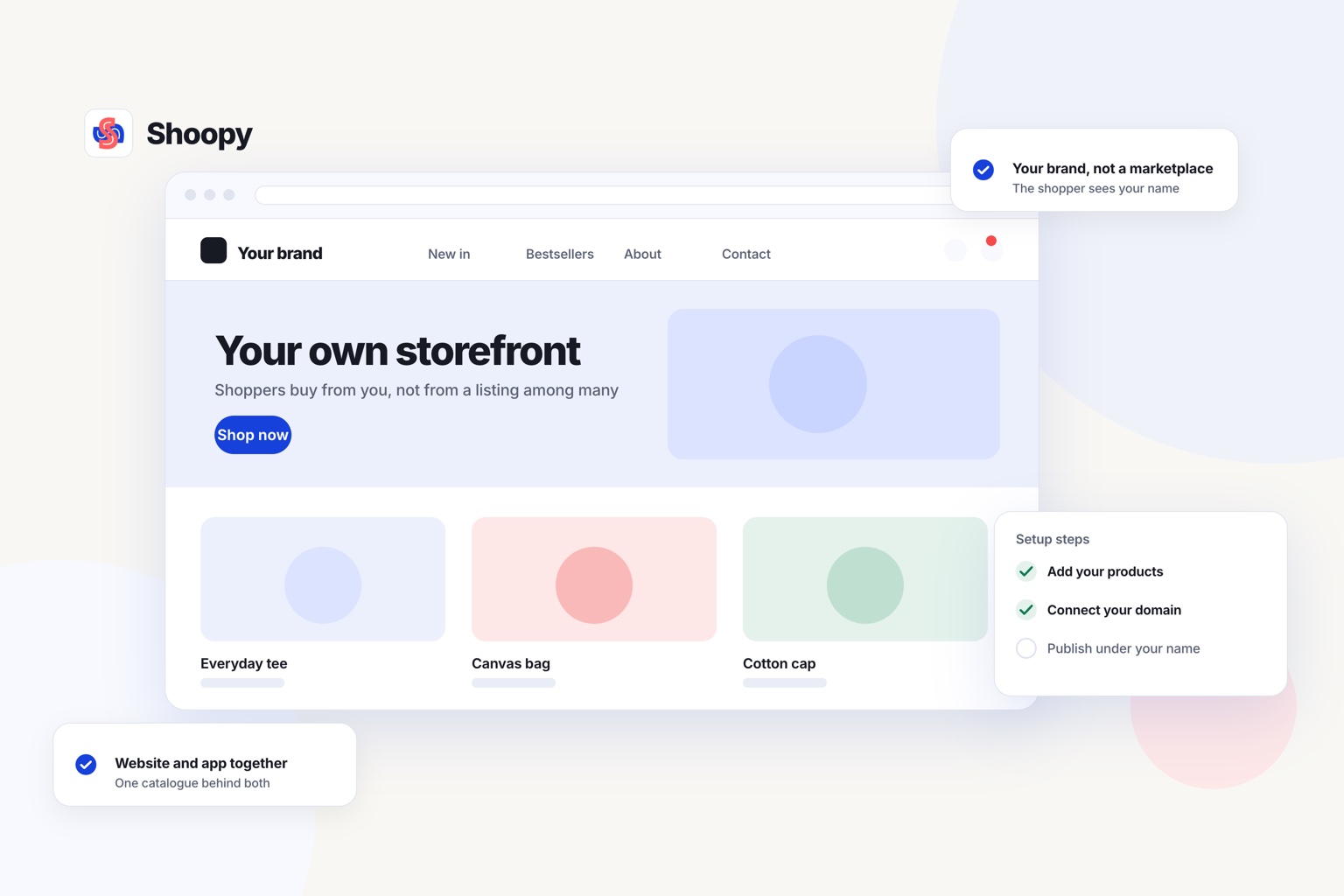
| Shoopy | A storefront on your own domain that reads the same catalogue as the counter and the branded app. Plans and current prices are on the pricing page | Do the counter and the online store read one catalogue, if you also run a shop? |
What should a clothing brand ask each vendor?
Read the middle column as each vendor’s own words, dated October 2026. Then put the question in the last column to each vendor, using one real product from your range.
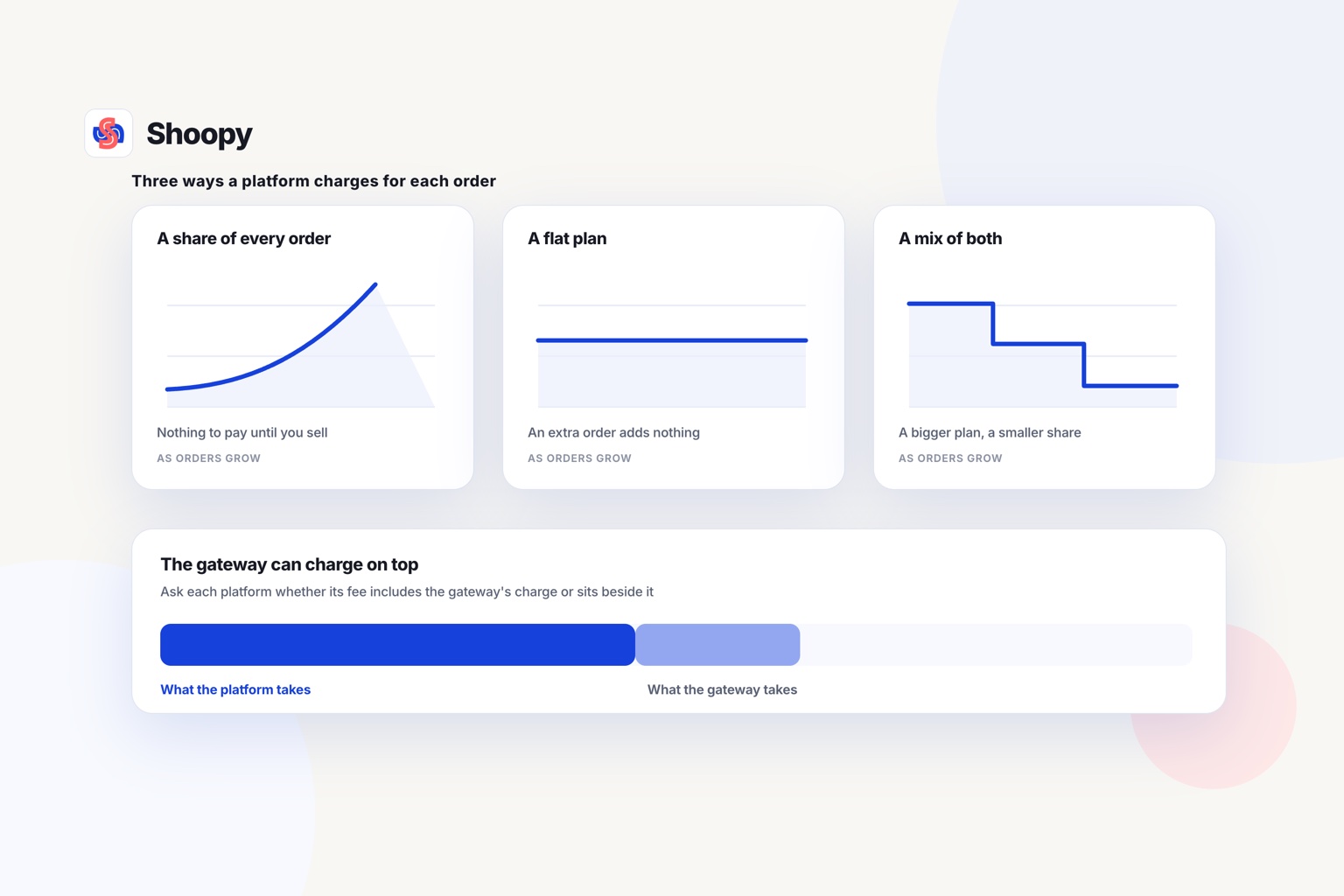
How do platform and gateway fees add up on a clothing order?
A prepaid clothing order can carry two fees: one from the platform and one from the payment gateway. A payment gateway is the company that moves the buyer’s money from the checkout to your bank.
For a fashion store in India, Razorpay and PayU are gateways you can connect at checkout. The table shows which platforms add their own percentage on each order. Other platforms set their fees differently, so read each one’s fee line next to its plan price. The gateway still charges its own fee.
What a percentage costs at your volume
Add up the value of last month’s prepaid orders. Multiply that total by the platform’s percentage, then add the gateway’s fee and any plan price. If the platform fee is 2%, a month of 500 prepaid orders costs you the value of 10 orders.
Run the same sum for the order count you expect in a year. A percentage that looks small at launch grows with every order you add.
What a return does to the fees
A returned dress can still leave fees behind. Ask the platform whether it gives back its own fee when you refund the buyer. Ask the gateway the same question about its fee.
Which payments and shipping does a fashion store in India need?
A fashion store in India needs UPI and cash on delivery at checkout, plus a courier that collects COD cash and picks up returns. UPI stands for Unified Payments Interface.
Cash on delivery (COD) lets the buyer pay at the door instead. If the buyer refuses the parcel, the courier carries it back to you. This is called RTO (return to origin), and your courier agreement sets what you pay for that trip.
Advance payment on COD lowers that risk. The buyer pays part of the order online and the rest in cash on delivery. A buyer who has already paid something has a reason to accept the parcel.
For each courier, check three things before you sign:
- PIN codes. Which PIN codes (postal codes) it delivers to, and which of them allow COD.
- COD cash. When it pays the cash it collects into your bank account.
- Return pickups. Whether it collects a return from the buyer’s address, or the buyer must post it.
Book one test return before you launch. Then you know how a wrong-size parcel comes back to you, and how long it takes.
What should the best ecommerce platform for a clothing brand include?
The best ecommerce platform for a clothing brand should include stock per size and colour, photos per colour, a size chart, exchanges and one order list.
Stock for each size and colour
Each size and colour of a product is a variant. A SKU (stock keeping unit) is the code for one variant, such as the black shirt in medium. The black medium and the black large need separate counts, or you will sell a size you no longer have.
For one example, see how store-level inventory sits behind one catalogue.
Photos for each colour
A buyer who picks navy should see navy, not the black shirt from the main photo. Attach photos to each colour, and shoot every product under the same light.
A size chart on the product page
Put the size chart on each product page, next to the size buttons. Give the measurements of the garment itself, not of the body, for every size you sell.
Exchanges as well as refunds
An exchange sends the buyer the right size in place of a refund. Check that the platform records the exchange against the first order. Then the stock of both sizes stays correct.
Do website, app and counter orders reach one list?
Website orders, app orders and counter sales should land in one list. Then one person can pack orders, book couriers and check returns from one screen.
What goes wrong with sizes, photos and returns, and how do you stop it?
Four problems are worth planning for: oversold sizes, wrong colours in photos, unclear return terms and refused COD parcels. Each one has a fix you can set up in advance.
Oversold sizes. A store that keeps one count per product, not per size, sells sizes that have run out. Keep a count for every variant, and recheck it after each return comes back.
Wrong colour. In India, rule 7 of the Consumer Protection (E-Commerce) Rules, 2020 stops a brand selling its own stock from refusing returns of misdescribed goods. A shirt that arrives darker than its photo may not match its listing. Shoot each colour under the same light, and check the photo against the garment before you publish it.
Unclear return terms. The same rule asks a brand to show its return, refund and exchange terms clearly, including the cost of return shipping. Link the terms from every product page and from the order confirmation.
Refused COD parcels. Call or message the buyer to confirm a COD order before the parcel leaves. A wrong address fixed at that point costs less than a parcel that comes back.
How do you match a platform to the way your brand sells?
Match it to three facts: who will build and run the store, how many orders you expect, and whether you also sell from a shop. The list below follows the kind of brand, not a ranking.
- You already use Shopify or plan to. Read its row in the table, and work out its fee at your real order count.
- You have your own developer. Look at WooCommerce, and read the boundary below.
- You are testing a small range with few orders. Compare the percentage rows in the table. A percentage can cost less than a plan price while orders are few.
- You sell from a shop and online. Shoopy runs the counter and the online store from one catalogue. Its checkout takes UPI and cash on delivery, with online payments through Razorpay or PayU.
One plain boundary
The WooCommerce comparison advises choosing WooCommerce if you need code-level control and have a developer on hand.
If you also run a shop, this post on running a counter and an online store together explains why one catalogue and one stock count matter.
To see a counter and an online store on one catalogue, look at how an online store on your own domain works, and book a demo from that page.
Frequently asked questions
How do I make a size chart for a clothing brand?
Lay one finished garment in each size flat on a table, and record its chest, waist, hip and length in centimetres, with inches beside them. Label each row with a size you sell, such as S, M, L and XL. Add one line on fit, such as relaxed or slim.
Should you charge for a return pickup?
It depends on who caused the return. Many brands carry the cost when the item is faulty or wrong, and pass it on when the buyer simply changed their mind. Whichever you choose, state it at checkout in the same words as the policy page, because a surprise charge is what turns a return into a complaint.
What should a clothing brand do about repeat returners?
Track them before you act. Pull the buyers with the most returns over a few months and look at what they ordered: one size, one colour, or everything. A pattern in the product is a listing problem to fix, while a pattern in one buyer is a decision about what you keep offering them.
How should I photograph clothes for an online store?
Shoot every colour you sell, and show the front, the back, a close-up of the fabric and one photo on a model. Use the same light and background for every product. Write the model’s height and the size worn, for example 5 feet 7 inches in size M.
How much does it cost to start a clothing business online in India?
The cost comes from five items: the platform plan, any platform fee on each order, the payment gateway’s fee, packaging and courier charges, and the stock you buy. COD adds the cost of parcels that come back unpaid. Add these for one month at your expected orders before you choose a platform.