 Shoopy
Ecommerce platforms in India with built-in GST invoicing for online orders (2026)
What an ecommerce platform with GST invoicing must put on the invoice for each online order in India under CGST rule 46, and what three platforms' pages say.
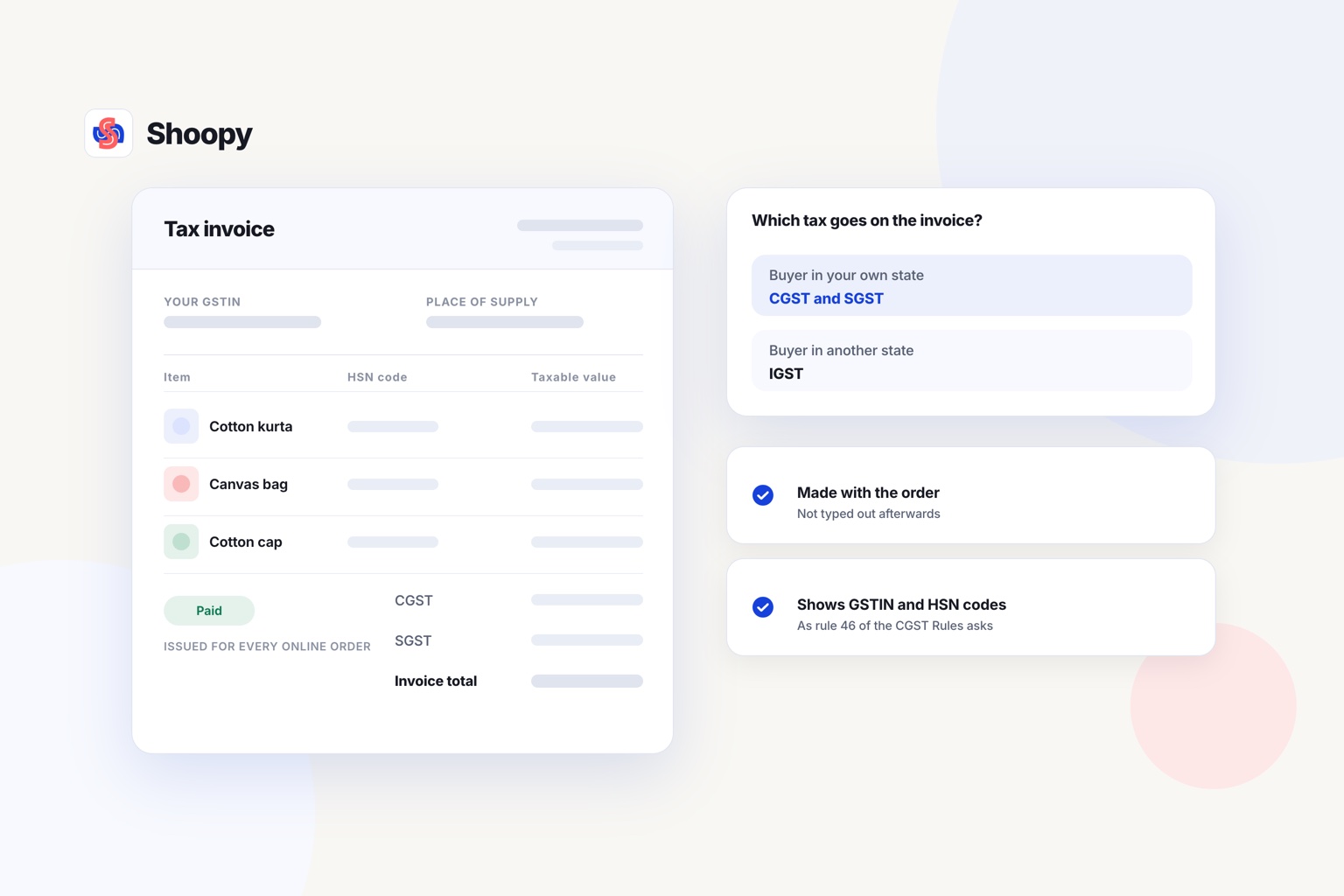
Quick Answer: An ecommerce platform in India has built-in GST invoicing when each online order creates a tax invoice under rule 46 of the CGST Rules. Shopify, StoreHippo and Shoopy are checked against that test. Shoopy creates a GST invoice for every online order, with CGST, SGST or IGST and HSN codes, and its counter billing also checks a business buyer’s GSTIN.
An ecommerce platform with GST invoicing built in makes the tax invoice from the order itself. Nobody copies the order into a second app or a spreadsheet. GST (Goods and Services Tax) is India’s tax on the supply of goods and services, and the Central Board of Indirect Taxes and Customs (CBIC) publishes its rules.
Which ecommerce platforms in India make a GST invoice for each online order?
The table below answers this for the three platforms in this guide, using what each platform’s own page says. Read the second column before you compare anything else.
| Platform | What its own page says about GST invoices for orders |
|---|---|
| Shopify | As of October 2026, Shopify’s GST in India FAQ says Shopify does not create a GST-compliant bill, and points sellers to a local third-party GST invoicing service or an app from the Shopify App Store. The same page says you cannot set multiple tax line items, so CGST and SGST are charged as one sum |
| StoreHippo | As of October 2026, StoreHippo’s order management page lists inbuilt and custom invoicing for B2B and B2C orders, and single or bulk GST invoices made with one click |
| Shoopy | GST billing makes invoices with CGST, SGST or IGST and HSN codes, validates a business buyer’s GSTIN, prints invoices on thermal or A4 paper, exports GSTR-1 data and issues credit notes. The online store reads the same catalogue as the counter, and each online order gets its own GST invoice |
For any other platform, such as Dukaan, Instamojo or Zoho Commerce, look in its help pages for a setting that creates a tax invoice for each order. If there is no such setting, or a person must type the order into a second tool, the invoicing is not built in.
What must a GST invoice for an online order show?
It must show the same fields as any tax invoice in India, which rule 46 of the CGST Rules lists. An online order gets no shorter version.
The fields that matter most for an online order are these:
- Your name, address and GSTIN (Goods and Services Tax Identification Number, your GST registration number).
- A serial number of up to 16 characters, unique for the financial year. You may run one series or several.
- The date of issue.
- The buyer’s name, address and GSTIN, when the buyer is registered.
- The HSN code (Harmonised System of Nomenclature, the code that classifies a product), with description, quantity and unit.
- The taxable value after any discount, and the total value.
- The rate and amount of each tax: central tax (CGST), State tax (SGST) or integrated tax (IGST).
- For an inter-State sale, the place of supply with the State name. Add the delivery address when it differs.
- Whether tax is payable on reverse charge, and your signature or digital signature.
What extra details can the invoice need?
In India, a sale of ₹50,000 or more to an unregistered buyer also needs the buyer’s address and delivery address with State code, under rule 46. Below that value, these details go on the invoice only when the buyer asks.
An electronic invoice made under the Information Technology Act, 2000 needs no signature. If your business must issue e-invoices, the invoice must also carry a QR code with its Invoice Reference Number (IRN).
How many HSN digits does the invoice need?
It depends on last year’s aggregate turnover. In India, Notification No. 78/2020-Central Tax, dated 15 October 2020 asks for 4 digits up to ₹5 crore of turnover and 6 digits above it.
A business under that limit may leave the HSN code off invoices to unregistered buyers, under the same notification. Check your catalogue holds the right code before your first online order, because the platform copies it onto every invoice.
How does the invoice choose CGST and SGST or IGST?
It compares your State with the place of supply. The same State means CGST plus SGST, and a different State means IGST.
Sections 7 and 8 of the Integrated Goods and Services Tax (IGST) Act, 2017 decide whether a sale is inter-State or intra-State. For goods sent to a buyer, section 10 of the same Act puts the place of supply where the movement of the goods ends for delivery.
Take a shop in Pune that sells a kurta to a buyer in Pune. The invoice shows CGST and SGST on two lines. The same kurta sent to a buyer in Jaipur shows one IGST line.
So the platform must read the delivery State on every order. It must also print the two taxes as separate lines. A single “tax” line does not show the split that rule 46 asks for.
What if your platform cannot make the GST invoice itself?
Then a separate invoicing app or service has to make it from each order. The order details must travel from the store to that app.
This works, but it adds one more step between the order and the invoice. If that step fails, an order ships without its invoice, or with the wrong State.
Check three things in any separate invoicing app:
- It reads the delivery State from each order.
- It takes HSN codes from your catalogue.
- It issues credit notes for returns.
Which mistakes cause wrong GST invoices on online orders, and how do you stop them?
Four problems are worth testing before you go live: missing HSN codes, the wrong State, returns handled as discounts, and broken invoice numbers. Each has a plain fix.
HSN codes in one catalogue only. When the counter’s billing tool has HSN codes and the online store does not, the same shirt goes out with two tax treatments. Keep one catalogue for the counter and the store, so a tax detail fixed once is fixed everywhere.
The wrong State. The tax follows the State where the delivery ends. Place one test order to an address in another State. The invoice should show IGST, not CGST and SGST.
Returns handled as discounts. A refund given as a discount on the next order leaves the first invoice unchanged. Issue a credit note against the original invoice instead. Section 34 of the CGST Act, 2017 allows a credit note when goods are returned.
Broken invoice numbers. Rule 46 asks for a serial number that is unique for the financial year. Online and counter sales may use separate series, as long as no number repeats.
This counter billing checklist has a ten-product HSN test you can run on your own catalogue.
Which ecommerce platform with GST invoicing fits which seller?
The fit depends on how you sell today: on a store you already run, to businesses online, or online with a counter. Match your case to a row in the table.
- You already run a store that works. Moving platforms takes time and carries risk. If your store runs on Shopify, read its row in the table first.
- You sell to businesses and consumers online. Check how each platform handles B2B invoices with the buyer’s GSTIN. Read the StoreHippo row for its invoice options.
- You bill at a counter and sell online. Shoopy runs counter billing and the online store on one catalogue. Bill a shirt at the counter and the online stock drops by one, with stock counted per shop. One boundary: the billing side prepares GSTR-1 data the way your CA files it, and you or your CA still file the return.
Frequently asked questions
Do I need to give a GST invoice for every online order?
Yes, for each taxable sale. Section 31 of the CGST Act, 2017 asks a registered seller of goods to issue a tax invoice before or at the time the goods leave for delivery. For low-value sales to unregistered buyers who do not ask for one, rule 46 allows a consolidated invoice at the close of each day.
What happens if a buyer gives the wrong GSTIN?
Check it before the invoice is raised, because a wrong GSTIN means the buyer cannot claim the tax. If the invoice has already gone out, cancel it with a credit note and raise a fresh one with the right number. Ask the buyer to confirm the GSTIN at checkout rather than after dispatch.
What is the difference between a tax invoice and a bill of supply?
A tax invoice charges GST and shows the tax split, while a bill of supply charges no GST. Under section 31 of the CGST Act, 2017, a seller of exempt goods or a composition taxpayer issues a bill of supply instead. Rule 49 asks it to carry the seller’s GSTIN, a serial number, the date and a description of the goods.
How long after the sale can a GST invoice for services be issued?
For most services, up to 30 days from the date of supply, under rule 47 of the CGST Rules. Goods work differently: their invoice is due before or at the time the goods are removed for delivery. A business that sells both goods and services needs each invoice timed to its own rule.
Do you need a separate invoice series for online orders?
You may keep one series or split it, as long as each number is unique and runs in sequence. Sellers who bill at a counter and online often keep separate series so the two channels are easy to read in the return. Decide once, write it down, and never reuse a number.